
Read Boise County Tax Records
Two custodians share the work behind Boise County property tax records. The Boise County Assessor estimates market value for ad valorem tax purposes and keeps the parcel attributes that feed the valuation. The Boise County Treasurer handles billing and collection. Setting taxing budgets and taking in the money fall outside the Assessor's role.
| Field | What It Shows | Where |
|---|---|---|
| Parcel identity | APN, acreage, situs and legal description | Assessor/GIS |
| Assessment fields | Property type, code area and valuation-related data | Assessor |
| Exemption status | Approved relief that may reduce taxable value | Assessor |
| Bill and payments | Charges, installments, receipts and unpaid status | Treasurer |
| Delinquency trail | Notice, redemption schedule and possible tax deed | Treasurer |
Idaho law starts with market value. Allowed exemptions come off that figure next. A county assessment is simply the Assessor's tax valuation for a stated cycle. It is not a listing price, a loan appraisal, or the recorded sale price. The tax bill comes last. That is where district levies get applied to taxable value under Idaho's system.
Boise Assessor and Treasurer Differ
The Assessor works out of the Miner’s Exchange Building at 420 Main in Idaho City, open weekdays from 8 to 5, phone 208-392-4415. Its Horseshoe Bend annex sits at 383 Highway 55, open weekdays 9 to 5 with a noon-to-1 lunch. Parcel identity, valuation questions, inspections, and exemption forms all belong at the Assessor's counter.
The Treasurer shares the 420 Main address and can be reached at 208-392-4441, with weekday hours from 8 to 5. Bills, receipts, payment history, delinquency, and tax-deed administration go through that office. Bring the same parcel number to each desk. A similar address or owner name alone can cause a mismatch between records.
Search Boise County Tax Fields
The Land Records and GIS system offers Search Address, Search Parcel, and Search Subdivision. Its ArcGIS layer tracks parcel number, acreage, owner fields, mailing and situs lines, legal description, tax area, code area, zoning, property type, map year, and an instrument string. The office publishes no owner filters beyond that documented layer, so treat undocumented result fields with care.
| Search path | Input | Tax use |
|---|---|---|
| Address | Property street address | Find the correct APN |
| Parcel | Complete RP number | Match assessment and bill |
| Subdivision | Plat name, then lot/block | Resolve a weak rural address |
| Point & Pay | Available bill-search prompt | Review or pay property taxes |
Look Up a Boise County Bill
Need a one-time property-tax search and payment? The Treasurer points to an official Point & Pay landing page. An account is optional and unlocks dashboard, autopay, notification, and history tools. Online payment carries a 2.5% convenience fee with a $2 minimum. Match the bill to the APN and tax year before paying.
- Find the parcel through the Assessor by address, parcel, or subdivision and copy the complete APN.
- Open Point & Pay and locate the matching property-tax account.
- Read the year, installments, payment status, and any prior balance. Save the receipt after payment.
- Check the Assessor record for the valuation and approved exemption that fed the bill.
- Call the Treasurer when a delinquency, tax-deed notice, or unclear payment history appears.
- Assessed value
- The Assessor's value used in the property-tax process.
- Levy
- A taxing district's rate applied within the tax calculation.
- Homeowner exemption
- Idaho relief for qualifying owner-occupied property under current rules.
- Tax lien
- The county's legal claim arising from unpaid property tax.
The official tax-bill source shows the current payment entry point.
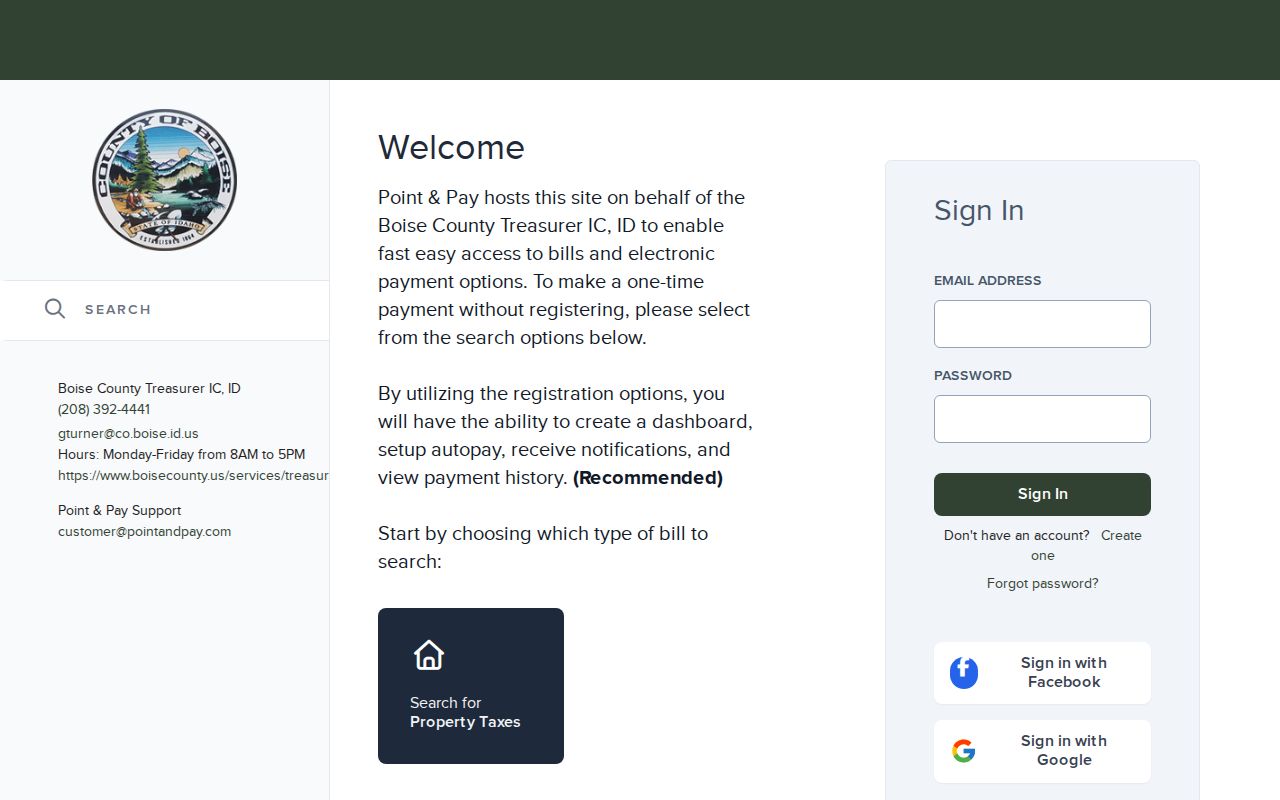
Keeping the one-time search separate from optional account tools helps. It prevents confusion between a portal login and access to the public tax record.
Boise Tax Installments Have Dates
Idaho property taxes may be paid in two installments, per the Treasurer. The first half is due December 20. The second half is due June 20. A due date can land on a weekend or holiday. Verify the operative deadline with the office. An owner remains responsible even when a bill never arrives.
Keep the mailed bill, portal confirmation, check image, or receipt. It should show the tax year and parcel number. That paper trail matters most when a parcel changed hands near a due date. It also helps when an escrow payment and the county posting appear out of sync.
Note: Confirm the current year's dates and balance with the Treasurer before relying on a saved portal view.
Boise Homeowner Exemption Records
The Assessor publishes a homeowner exemption and sales-verification form. Its fields cover parcel, purchase, occupancy, and primary-residence facts. Idaho Code §63-602G governs the exemption. Current eligibility rules and filing instructions come from the Assessor.
An exemption entry can explain why taxable value differs between two otherwise similar parcels. It does not prove who occupies a home on a given day. Ask the Assessor whether an exemption has been approved. Ask which tax year it affects and what documentation a correction requires.
Boise County Uses Market Value
The Idaho State Tax Commission explains that assessment starts with market value. Exemptions are subtracted from that value. Boise County relies on approved mass-appraisal methods. It inspects property on a five-year cycle. That cycle spreads physical review over time. It does not freeze the value for five years.
Ratio studies compare assessed values against market and sale evidence at a broad level. They do not hand you a private appraisal for one parcel. For a sale-price question, check the recorded transfer and any sale evidence. For a taxable-value question, use the Assessor's notice and roll.
The state guide sums up the rules framing Boise County property tax records.
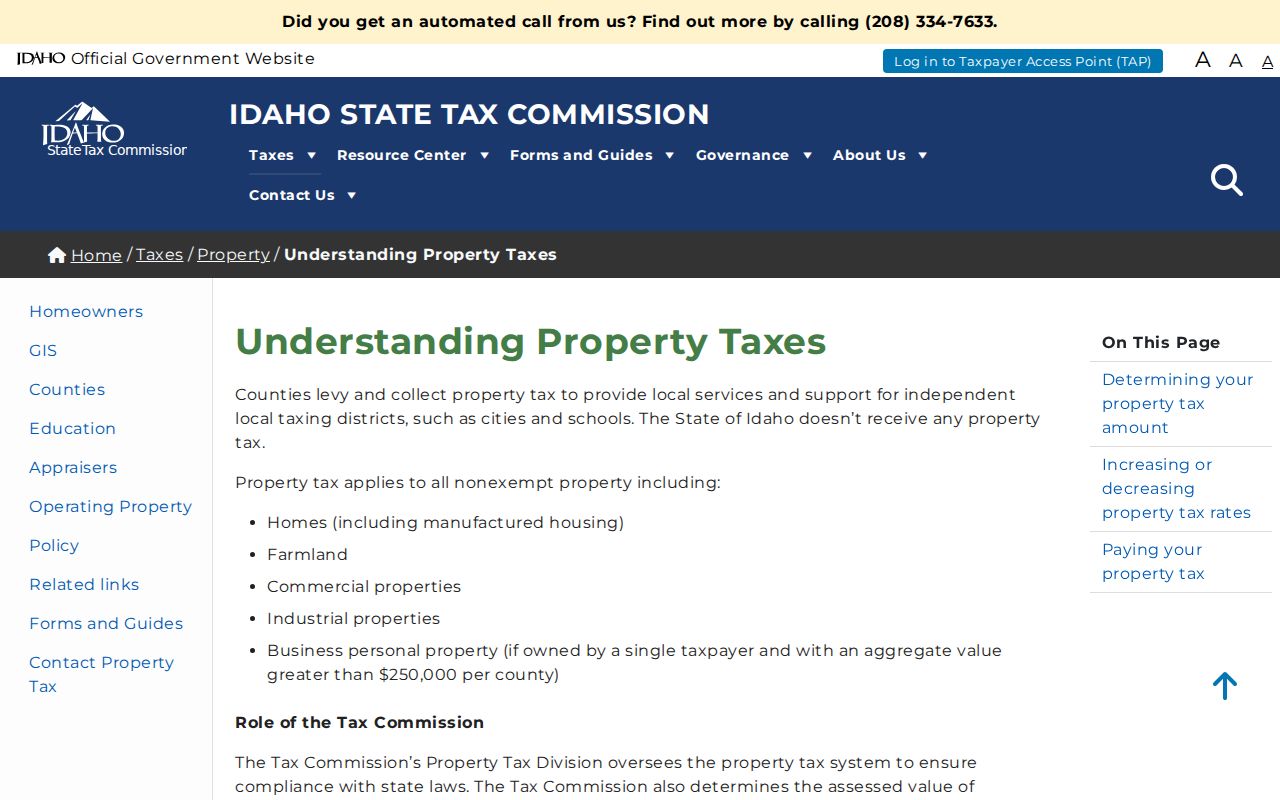
The state guide lays out the market-value and appeal framework. The parcel-specific figures stay with the county offices as custodians.
Delinquent Boise Taxes Become Deeds
Delinquency moves in stages. An auction never happens overnight. The Treasurer's current notice for 2023 delinquent taxes describes 2026 notice activity, 2027 redemption milestones, and a possible 2028 auction. Those dates can shift. Treat any list or notice as a working schedule, never a permanent one.
Match the name, APN, tax year, legal description, and notice stage before relying on what an older web notice shows. Ask the Treasurer for the current amount and redemption status. A later payment, correction, court order, or postponement can change the picture, and if a tax deed records, the Recorder keeps that instrument as part of the title chain.
Appeal a Boise County Assessment
Start with the Assessor the day the assessment notice arrives. Check the record first. Compare the parcel identity, acreage, property type, improvements, exemption status, and other factual characteristics against the file. Evidence makes the case. Photos, a survey, repair estimates, and an independent appraisal all strengthen it. Comparable sales help too. So do documents showing a wrong parcel fact.
Idaho's property-tax guidance sets the deadline. An appeal goes to the Boise County Board of Equalization. It must be filed by the fourth Monday in June. Use the current county form and instructions, since calendar dates change each year. Keep proof of timely filing and a copy of every exhibit. If the dispute is a payment rather than the valuation, take that to the Treasurer.
Appeal window. File with the Boise County Board of Equalization by the fourth Monday in June under the current Idaho schedule. Confirm the exact date and form each year.
Property tax records support the appeal. They cannot argue it alone. A clear parcel error paired with focused market evidence does more than a general claim that the bill simply feels high.